
Staff Writer Foo Yan Ning ruminates on the musicality of The Violinist (2026) and discusses the universal quality of Ervin Han & Raul Garcia’s animated feature.
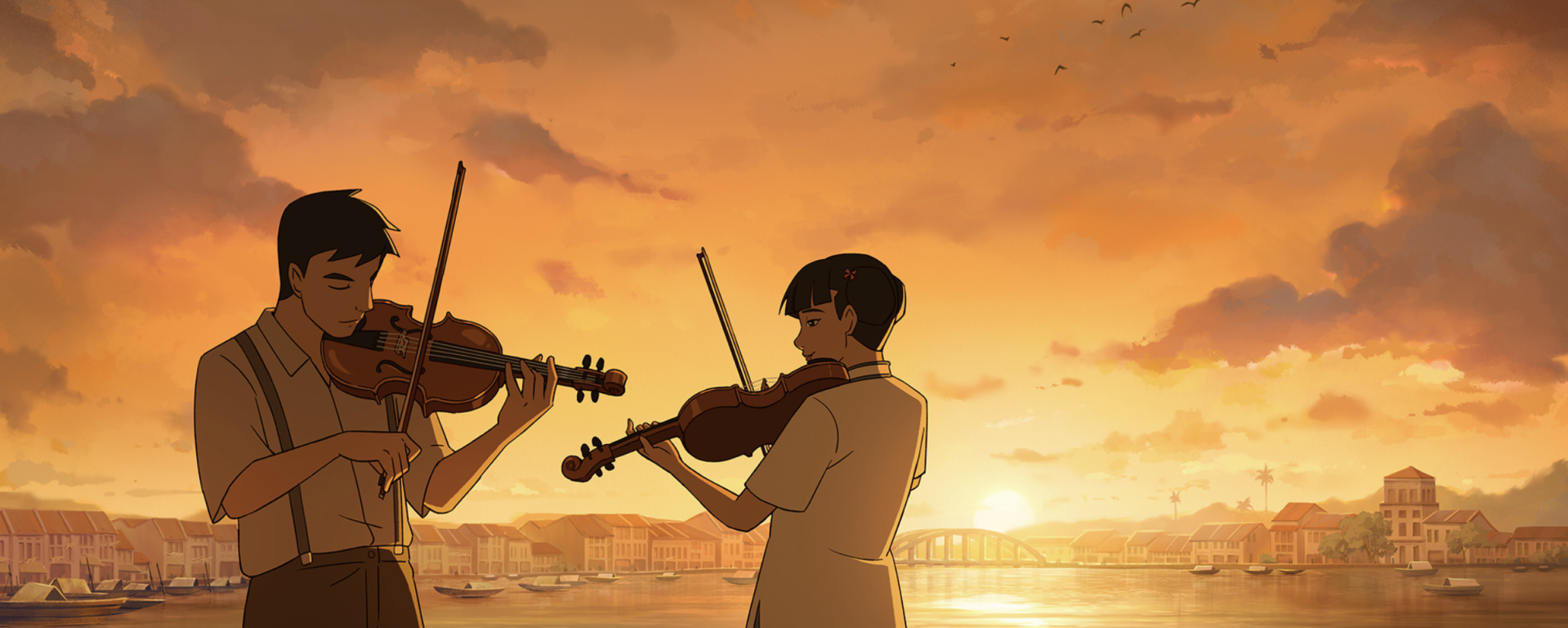
Image taken from Bakchormeeboy
“The violin is the closest sound to a human voice.”
This line remained etched in my mind even as I left the theatres after watching Ervin Han and Raul Garcia’s animated feature The Violinist (2026) – Singapore’s first animated feature film in 15 years. A heartwarming narrative set pre-WWII and during the Japanese Occupation in Singapore and Malaya, the film follows a musically-talented pair – Kai and Yi Fei – and their journey of love, hope and sacrifice.
The film has become a national treasure, earning itself an 11-minute standing ovation and winning the top award at the 50th Annecy International Animation Film Festival. Local audiences laud the film for putting Singapore in the spotlight in the world of animations, pouring appreciation for the gorgeous illustrations of familiar landmarks and olden day Singapore on the cinema screen. Indeed, we beam with patriotism when Singaporeans perform well on the global stage. I, myself, am no different. I had already entered the cinema with a preconceived sense of pride and admiration just because the film was made by a Singaporean.
Yet, what I took away from the film was not the fact that it was a production “made in Singapore”. From the artwork, to the storytelling, and most importantly the music, the film represented so much more than just “local cinema”; it represented the power of emotions behind local art that can transcend beyond our island’s shores. It was when the film started to feel less like an animation about Singapore, and more like a moving film about the quiet but potent power of music, that I found myself further drawn into the world of The Violinist.
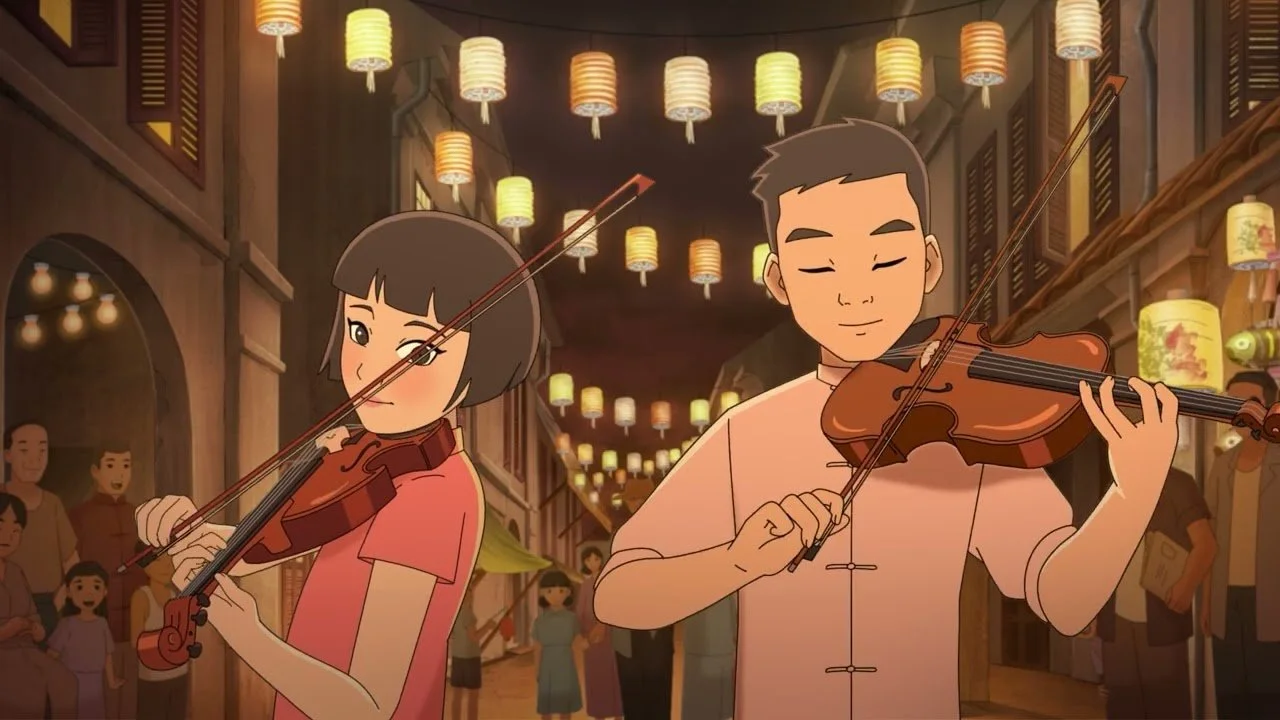
Image taken from CartoonBrew
The animation resembles illustrations from a local history textbook rather than popular animation styles – like Anime or Disney/Pixar house-styles – and while it isn’t particularly unique, the simplicity of the film’s animation gives it charm. It feels humble and down to earth, illustrating the directors’ genuine love and care for their story. The medium itself paints a much richer story for the film. Rather than using intense colour schemes and insanely detailed artwork to depict the narrative, the animation allows the classical soundtrack and emotional script to complete the artwork shown on the screen.
Han and Garcia leverage on the emotional height of despair and loss during wartime to develop a universal story that resonates with all audiences. At the root of the film is Kai and Yi Fei’s unconditional love for music and performance, using it as a representation of hope amidst darkness and tumultuous times. With the volatile nature of the world order today, The Violinist stands out as a timeless reminder of the power of art in uplifting humanity.
One of the most moving scenes from the film was when Yi Fei was playing her violin in the middle of the night for the two orphans she had taken under her wing. As she performed a melodious and familiar tune, people shivering and cowering in their homes all perked their ears to her music. For a moment, it felt as though everything was going to be okay. And even more than hope, The Violinist highlights how music is the language we all speak. When the Japanese soldier listened to Yi Fei playing the violin in her house, it was as though time stood still. The power disparity between the Japanese soldier and Yi Fei dissolved into a pure moment of human connection. Despite having different backgrounds, speaking different languages and standing on opposite ends of the war, the lyricless music brought together the Japanese soldier and Yi Fei in a true showing of humanity. Most pertinently, music became a vessel that connected Yi Fei to Kai despite their separation during and after the war. In a relentless search to find her way back to Kai, music became Yi Fei’s reminder that Kai’s spirit and soul would still stay with her no matter the distance. The same melody Kai composed once felt haunting to her, but it eventually brought her comfort in knowing his dream lived on in their music. After all, music knows no boundaries – it can rally people in times of trouble, connect individuals in moments of vulnerability, and inspire hope in the darkest of days. This is exactly what makes The Violinist such a powerful film amidst an age of separatism and chaos.
Of course, the film is still far from perfect. There has been some criticism regarding the lack of minority representation in the film, which can be problematic considering the multiracial backdrop of Singapore. Delivering the entire original film in English as the main language used also raised some eyebrows as it seems to take away the historical accuracy of the context in which the film is set. Yet, I find such comments to be a rather myopic view of the animation. I believe Han and Garcia had hoped to bring to life a piece of history so near and dear to Singaporeans in a medium that can connect to audiences beyond our island. These intentional choices of the directors were not meant to dampen the local flavour of the film, but rather enhance its appeal as a timeless story relatable to all. Some might also consider the storytelling far too melodramatic and cliché, while others highlight the highly idealistic nature of the characters. But isn’t that exactly the point of animation? To invite us into a world different from reality and offer introspection we might not experience in our pragmatic society? If anything, these narrative choices are exactly what make The Violinist such an alluring animation.
More than just a Singapore story, The Violinist explores very human and universal emotions through a simple yet moving story. In a time where artificial intelligence seems to be an imminent monster encroaching upon the art and film industry, the painstaking years of hand drawn 2D animation frames to complete The Violinist deeply inspire hope. Truly, nothing beats the purity of human storytelling.
IMAGES IN THIS ARTICLE ARE BEING USED UNDER THE FAIR USE GUIDELINES AS PART OF SINGAPORE'S COPYRIGHT ACT 2021