
Staff Writer Naomi Tan meditates on what it means to rise above the existentialist despair of modern times and truly live in Cronenberg’s Crash (1996).
Considered to be one of controversial director David Cronenberg’s best, Crash (1996) follows James Ballard who, after surviving a car crash, finds himself turned on by car accidents and becomes involved in a cult-like following of like-minded souls. Its hypersexuality and inhumane depravity surprisingly lends itself to an unabashed portrayal of the very human struggle of existentialist despair in an age where robotic monotony has taken over.
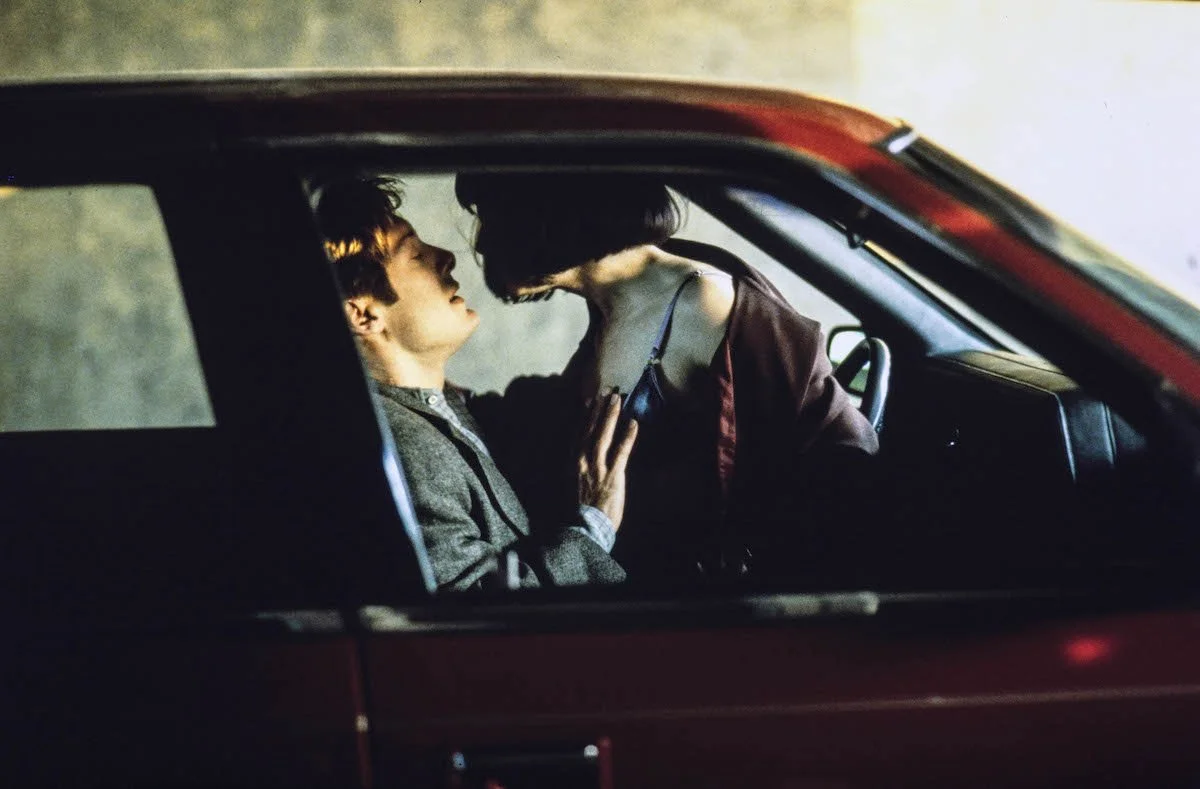
Image taken from Frame Rated
Crash is less about kink-discovery than it is pathetic desperation. James’ fascination and willingness to learn more about this sadistic culture is born from his own dissatisfaction in his sex life. He and his wife Catherine are in an open relationship, involving themselves in what most people would consider unconventional and illicit affairs. And yet, James finds himself more entranced by the never-ending freeway that encompasses the view from his balcony after failing to climax time and time again. What would seemingly be the most exciting and thrilling part of his life is turned into nothing more than a chore, especially when the misery of the industrial wasteland swallows up any iota of desire. Cronenberg displays life in Toronto as bleak and tired, a city completely devoid of life other than the heavyweight automobiles that pack the streets and the mysterious silhouettes behind their wheels. The city mirrors James, and effectively conveys the hopelessness that he has succumbed to.
This mechanical hopelessness penetrates James’ personal pleasure, turning it into a logistical nuisance. James and the rest of the group turn to more and more outrageous forms of pleasure, inching closer towards the edge of danger, as they chase the highs of their increasingly deviant sexual acts. In one scene, James has a tryst with one of the group members, Gabrielle, who dons restrictive steel braces which prop up the yonic scar on the back of her leg. The both of them twist and contort themselves into a car, trying to overcome the rigidity of its interior. James finally rips open Gabrielle’s fishnets and penetrates the scar. From the claustrophobic close-ups in the enclosed space, to the unadulterated need that crushes the otherwise unyielding automobile, the scene stings so strongly of want and greed, and is so jarring and sexually charged it makes you wince. The film arouses these uncomfortable feelings in the audience to make James’ ferocious need for satisfaction even more prevalent, along with his heightened inability to feel.
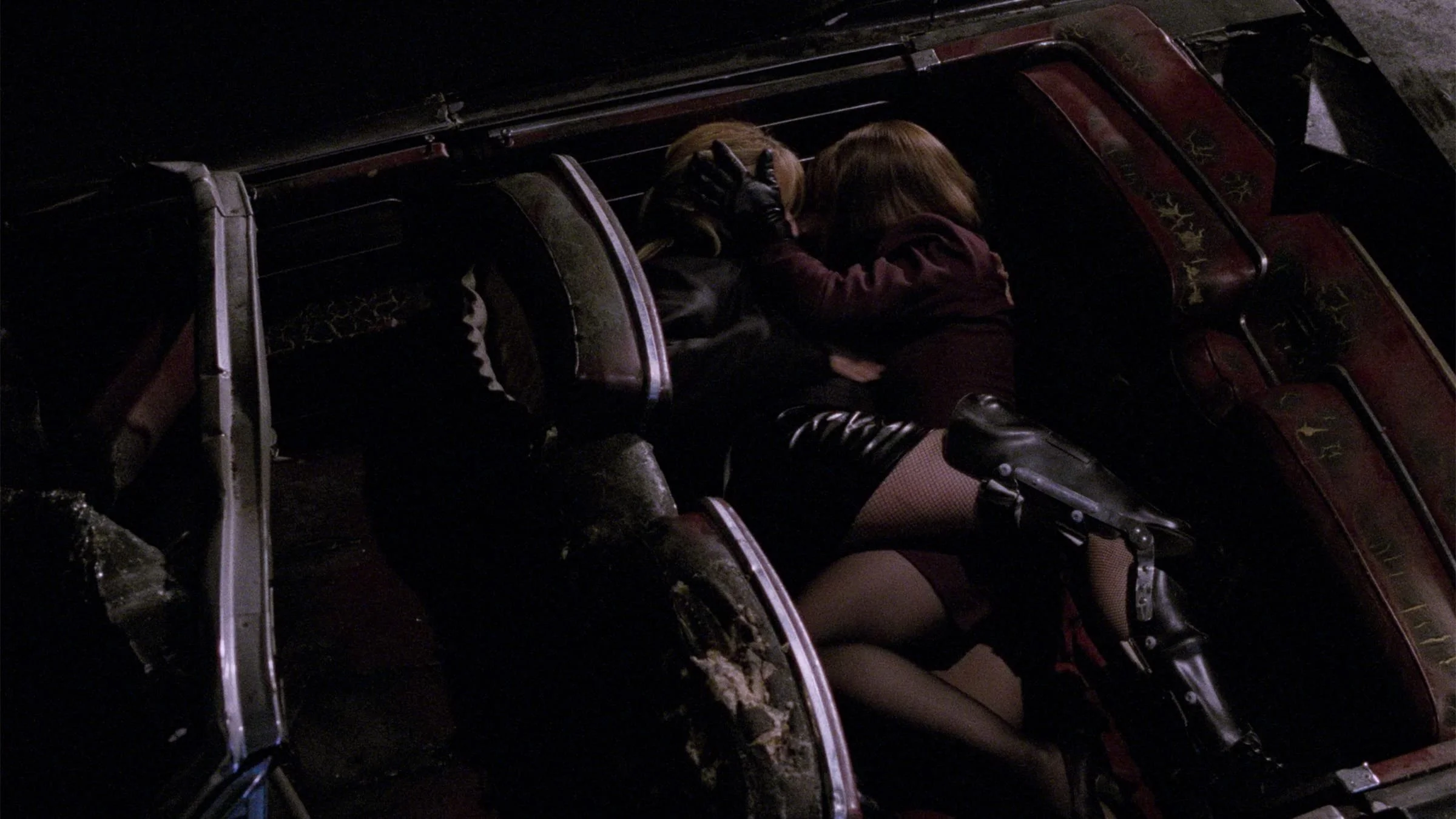
Image taken from The Criterion Collection
It's easy to write the film off as a crass display of pornography or a radical act of self acceptance, but that is such a disservice to the reality that Crash is a film constantly at odds with itself. The characters exist in a sort of limbo; fulfilling the animalistic repetition of sexual intercourse against the backdrop of a decaying city, but never reaping the soulful pleasure of these acts. The film turns pleasure into a practical act of survival for them, calling into question the very meaning of these outrageous acts if the goal isn’t even to enjoy them.
This conflict consumes all of the characters, but most notably applies to Vaughan, the group leader. When James is first introduced to the group, it is at one of his performance pieces, recreating the car crash that killed screen icon James Dean, a part of his project to live out the “benevolent psychopathology that beckons toward us”. Vaughan is grimy, covered in wounds and has a stare as blinding as a pair of headlights. And yet, he possesses the most passionate adoration for his art, becoming the physical manifestation of this conflict. Perhaps, for him, no amount of his depravity can take away the kindness of it, and maybe that is enough. In another scene, he visits a medical tattooist and asks her to messily ink car emblems on his chest, stating that it is a prophetic tattoo and “prophecies are ragged and dirty”. Vaughan knows how it will end, and knowing it is maybe the only thing that keeps him alive. Much of the thrill of this act is that death is around every corner, and perhaps by radically accepting it, titillating it to its extremes, it will seem much less daunting when it eventually arrives. And possibly, that is what translates survival into life with meaning.
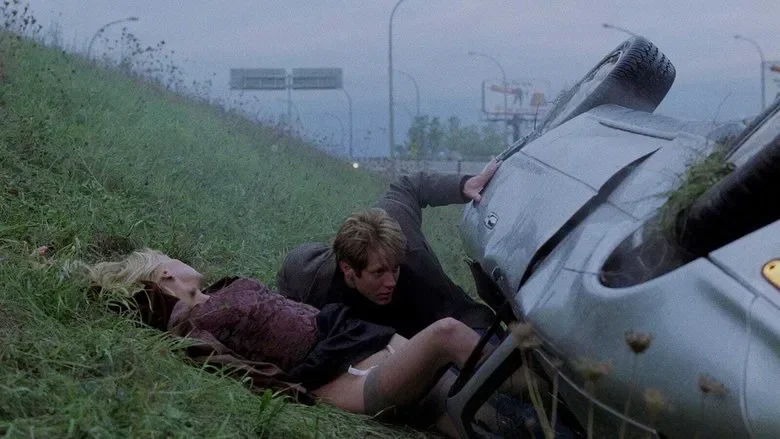
Image taken from The Movie Database
Crash understands that all things, good or bad, must come to an end. But it also understands that it can start again. In the last minutes of the film, Vaughan eventually dies after driving his car off an overpass and into a bus. Immediately after, we see Gabrielle and another group member visit the junkyard and passionately kiss amidst the wreckage of his car. Placing birth and decay so close to each other brings them into simultaneity – all parts of a system that perpetuates endlessly.
In the final scene, James pursues Catherine who topples into a grassy patch beside the freeway. James finds her as they begin to have sex under Catherine’s overturned car, as he whispers into her ear, “maybe the next one”, the same thing she told him at the beginning of the film. This further emphasizes the cyclical nature of the film, acting almost as a metaphor for the characters. The luscious greenery is also a first, albeit surrounded by the endless snakes of concrete, representing a possible return to nature and the reigniting of their humanity. They live, and they will find a reason to keep trudging on, no matter what it may be.
Crash is ultimately a story about what it is to be human, carrying an air of complete and radical non-judgement, inviting the chaos, the messiness, and the grotesqueness of life. It is a very necessary piece in today’s canon, dominated by milquetoast depictions of humanity. In an age where we have become prisoners to our technology, I wonder how much we can learn from Crash to weaponise or utilise these new discoveries to find out more about ourselves.