
The Odyssey: One Man’s Story
Editor-In-Chief Navina Nadaraj examines how The Odyssey explores the subjectivity of truth and the power of story and narrative through challenging the idea of the ‘hero’.
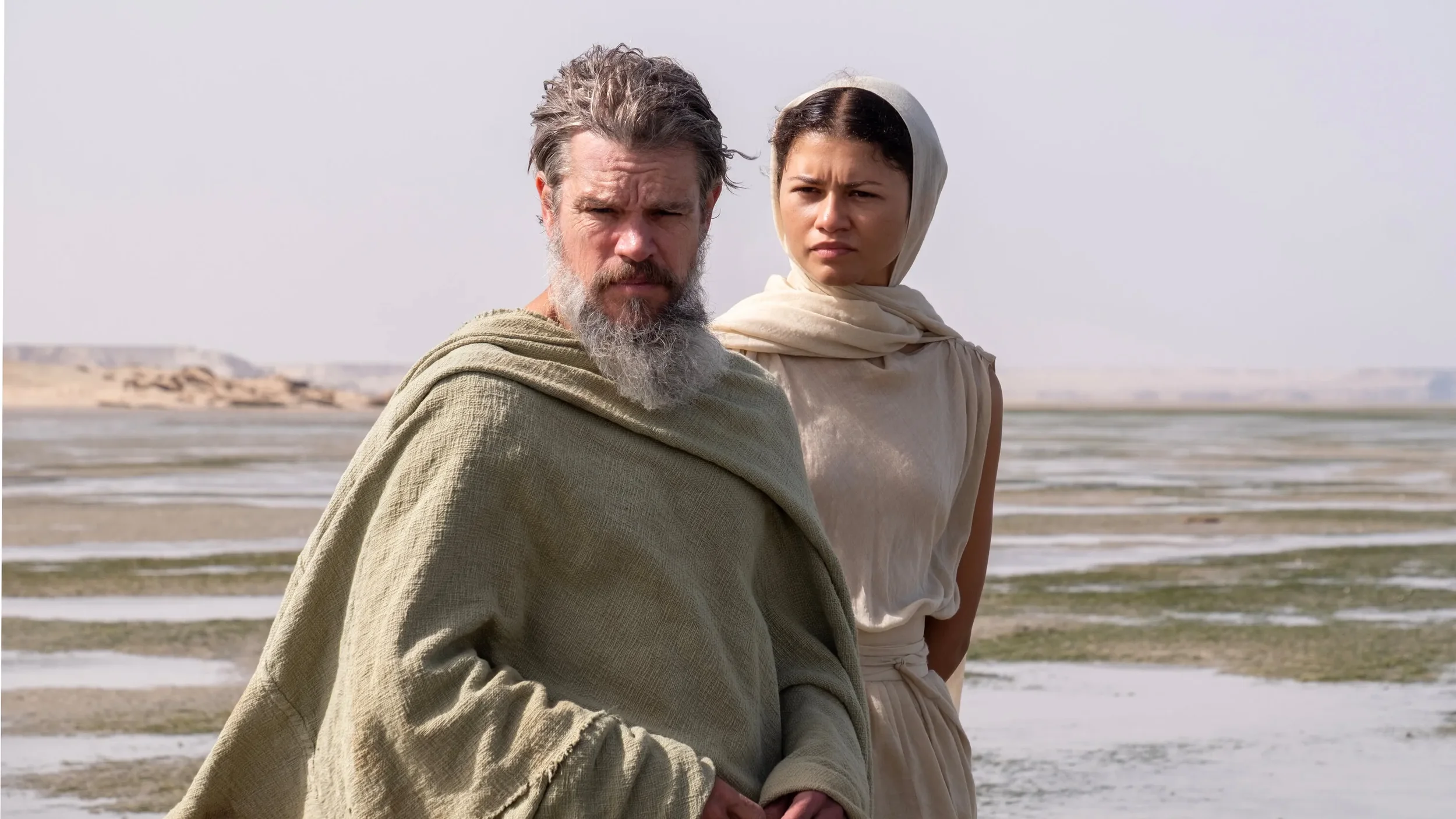
Image taken from The New York Times
Christopher Nolan’s The Odyssey follows the hero and King of Ithaca, Odysseus, on his twenty year journey home after the Trojan War, which is riddled with obstacles. The original text of The Odyssey by Homer was first told through songs and word of mouth and only later moved from the oral form into the literary. The possibilities were endless and the biases of these various storytellers contributed to what kind of story The Odyssey became. The original tale was told with Odysseus as the narrator, through social and oral storytelling, where he pridefully makes himself out to be the hero, as compared to the film that is told in a partially non-linear narrative with no true narrator. Other interpretations of the text include a feminist lens, a postcolonial lens and a psychological lens to name a few. The various perspectives make us wonder, what does Nolan want to tell us with his interpretation?
Nolan strips away the control of the storyteller Odysseus and presents the tale through unreliable, neutral perspectives and a partially non-linear narrative, reframing our feelings for Odysseus by challenging the narrative of the protagonist as hero through the subjectivity of truth. The Odyssey presents Odysseus as a controversial figure, despite the songs of heroism that the bard sings throughout the film, representing him as a “great warrior”. Through the course of the film, Odysseus goes from war hero to a man who has devastated and violated people through manipulation, and is haunted by his decisions and the consequences of the war.
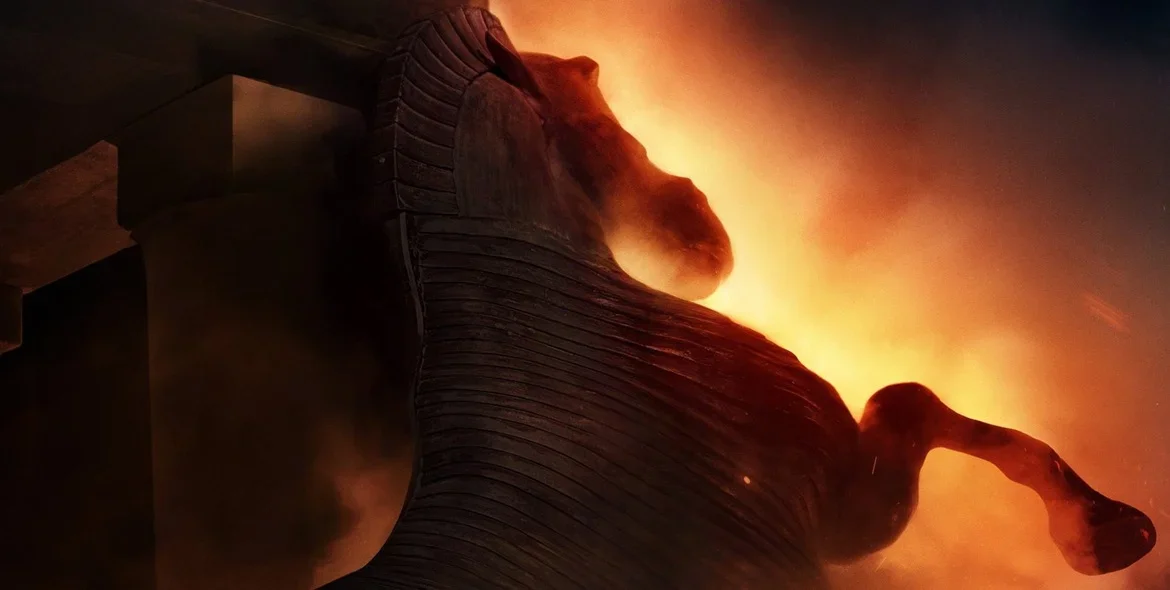
Image taken from In Review Online
The film opens and closes with the Trojan Horse. It first begins as the centerpiece for the stratagem to infiltrate and conquer Troy, presented to the citizens as a sacred peace offering to the goddess Athena. By the end of the film, we see the horse in flames along with Troy itself. The horse’s supposed status as a peace offering is betrayed in the pursuit of success, along with the statue of Athena that is beheaded by Odysseus’s men. The flames parallel the gross violation of trust that they have committed, violating and weaponizing Zeus’s Law – which states to treat others as they would their Gods. By disrespecting a sacred offering and Athena herself, they have disrespected Troy, and are punished with the perilous journey home.
The manipulation of truth is shown to us through the different perspectives in which we see the invasion, where at first, it is heroic and a genius method, but by the end of the film, shows the true gritty nature of the war and Odysseus’s lies and manipulation. Every obstacle that he has faced mirrors the transgressions committed at Troy itself and forces him to confront his guilt and his actions. The burning Trojan Horse symbolizes a moral collapse for Odysseus, instead of being a trustworthy hero, he manipulates the trust of those around him, degrading his own morals to do so.
The character of Sinon acts as a vessel to portray the guilt that Odysseus feels. In the original text, Sinon was a malicious liar, but Nolan turns him into an honorable soldier. Sinon was left on the beach to deliver the Trojan Horse to the Trojans, unaware that Odysseus and the other soldiers were hiding in the Trojan Horse. Odysseus chooses to keep him in the dark about the true nature of the “gift”, believing it to be a sincere peace offering. He is ultimately killed by Trojan soldiers. Sinon is one of the first characters we see on-screen and while it may seem like he has no significance, he actually becomes one of the most haunting figures in the film. Odysseus manipulates the truth, knowing that if Sinon truly believes the horse is an innocent peace offering, the lie would be more believable, mentioning “I needed you to believe because dying men talk,” to Sinon, whose bravery and loyalty is weaponised, ultimately using him as bait.
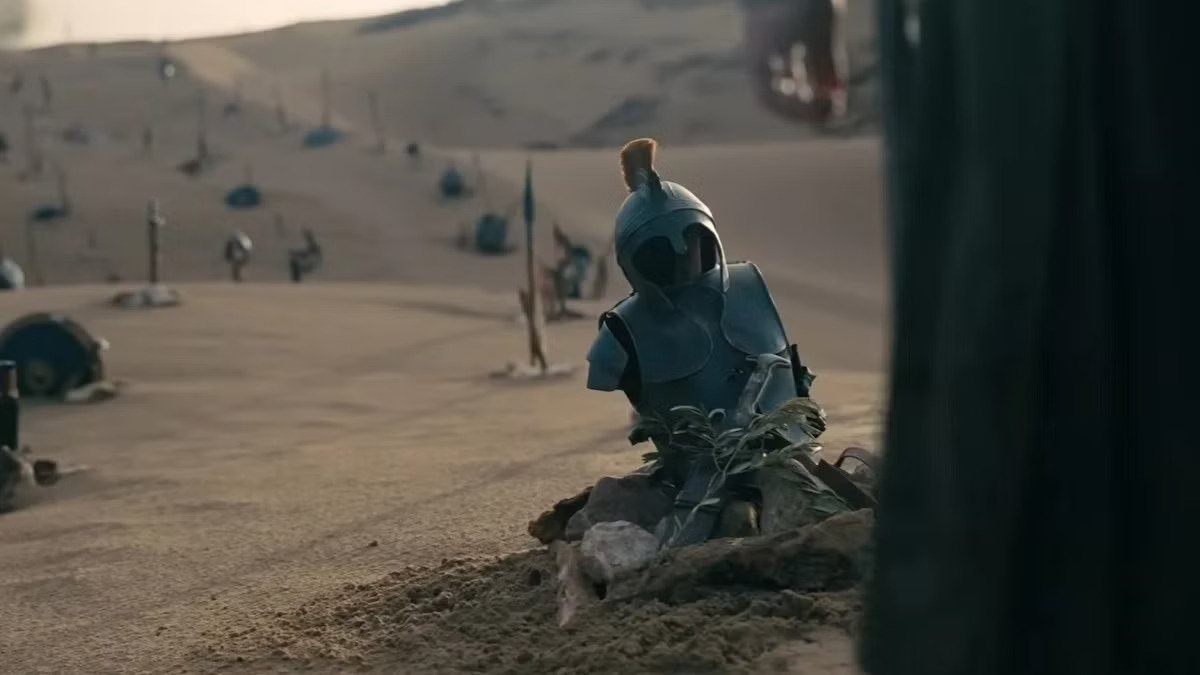
Image taken from Polygon
When Odysseus is confronted by Sinon in the Underworld, he questions Odysseus directly on his manipulation, causing Odysseus to reflect on his actions, questioning himself on whether he is truly a hero, or a monster that revels in false heroics. Nolan forces us into an uncomfortable position of questioning his morality. Odysseus instead takes shortcuts, hiding information from his men and making decisions for himself. Because of this, soldiers are sacrificed and killed, led into deception by a man they have trusted to lead them into victory and back home. Homer shows him lying to outsmart monsters and danger to return home safely to his throne, being praised for his intelligence and tricks, while Nolan frames his journey as one muddled by trauma and avoidance of the victorious homecoming, and the hero’s journey is subverted to a hero that is using deception to defend himself against his own trauma.
Another character that stood out to me was Agamemnon. Agamemnon is described as a figure that towers over individuals in stature and in power. Throughout the film, the Greek soldiers view him with reverence and dread, cowering in his fear and power. However, Agamemnon never really does anything. Instead of seeing him commanding fleets, or fighting battles, he rarely involves himself physically. In fact, everything great about Agamemnon was spoken instead of shown. As an audience, we are subjected to thinking that he is a terrifying and powerful figure, only to realise that he, like Odysseus, will do whatever they have to for the mission to succeed, even if that means bending the truth in his favour. He was not the hero he was presented to be, the same way Odysseus is not the hero we were told he was. Agamemnon believes in the righteousness of what he has done, and uses that to justify his actions instead of being haunted by it, while Odysseus is forever haunted by trauma and guilt of his choices no matter where he goes.
Nolan subverts the idea of the conventional hero, focusing on the uncomfortable truth of war and the trauma that haunts Odysseus. He did what he had to to survive, and by taking away the control that Odysseus had over his own story, Nolan forces us to engage with his journey objectively and reveal a broken soldier haunted by guilt and changed by the consequences of his choices.
images in this article are being used under the fair use guidelines as part of singapore's copyright act 2021