
The Backslidden Nonbeliever’s Take on Wake Up Dead Man
Guest Writer Megan Lin considers how Wake Up Dead Man succeeds in being a memorable addition to the murder mystery genre–and the Knives Out franchise–not simply due to the performances in the film, but also through its exploration of power dynamics within religious institutions and narratives. And in extension, how the film is able to examine the complexities of faith earnestly and respectfully.
This review contains spoilers
As an avid fan of detective stories and whodunnits, there was absolutely no scenario in which I was not immediately seated for Rian Johnson's Wake Up Dead Man (2025) as soon as it was released on Netflix. And safe to say, it's in my opinion, one of the best films of the last year.
Wake Up Dead Man is the latest instalment in the beloved Knives Out franchise, a series of murder mystery films helmed by the well-dressed and endearing detective Benoit Blanc (Daniel Craig). Each film is supported by a large ensemble of characters, oftentimes played by well-known Hollywood stars such as Kate Hudson or Chris Evans. Due to this, the announcement of the cast always plays a part in the hype surrounding the films. The first of the franchise, Knives Out (2019), was released in theatres and well received by both critics and general audiences alike. Although Craig’s Blanc is not the first detective to grace our screens–noteworthy predecessors like Hercule Poirot and Sherlock Holmes certainly comes to mind–Knives Out distinguishes itself by subverting the conventions of detective stories, most notably by focusing on the protagonist and the theme they embody, rather than the detective. As the charm of the films also lie partly in the bond formed between Blanc and the protagonist, this particularly resonates in Wake Up Dead Men–which most agree, is the most thematically rich of the franchise so far, and could only be delivered as successfully as it was because of the refreshing performances given by the titular cast members.
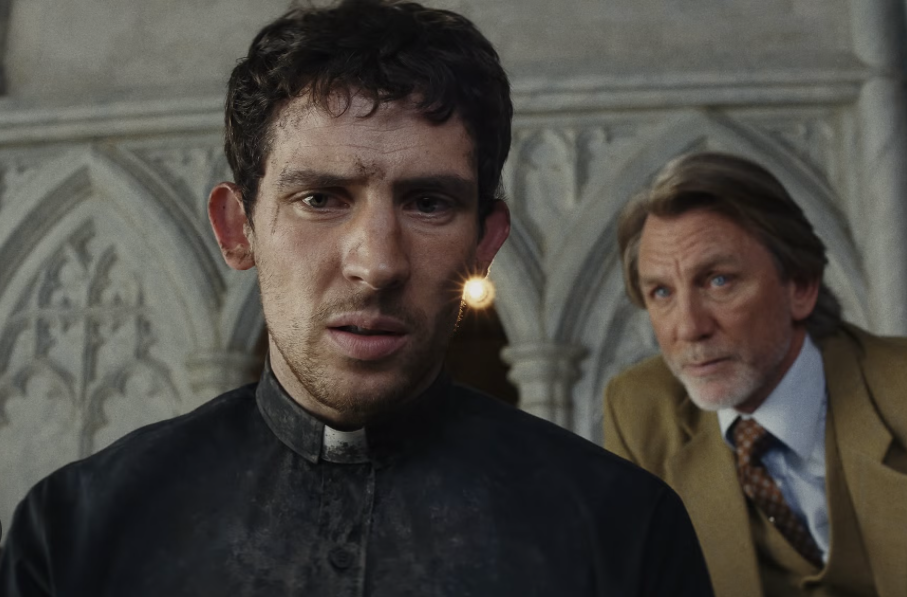
Image taken from Esquire
The conflict of the film is exemplified by Monsignor Jefferson Wicks (Josh Brolin) and Father Jud Duplency (Josh O’Connor). The former is a manipulative priest whose actions and manner of speaking is reminiscent of megachurch preachers, who has created a wealth-obsessed and patriarchal cult of personality that spreads hatred and bigotry instead of practicing faith. Meanwhile, Jud’s character serves as a foil to, and a critique of, the egotistical Wicks as well as the hypocritical institution he represents. And O’Connor delivers one of his best performances as the humble and honest practitioner of faith who only wish to help those that seek solace in the Church.
Beyond religious practice, another theme the film explores is how power is enforced through narratives. As with the other Knives Out films, Wake Up Dead Man devolves into more of a Why-dunnit instead of a common Who-dunnit at the halfway point of the film. Unlike in the other Knives Out films however, I would argue that Johnson does not utilize any red herrings or twists to mislead the audience. The mystery itself takes a backseat as the films progress, and the audience is allowed to dwell on the humanity found in the centre of the tragedies. Instead of the familial drama of the first instalment or the ‘eat the rich’ commentary of the second, viewers are brought into the world of religion, specifically Catholicism. Believers and non-believers alike may recognise the familiar rifts explored in the film–how misguided engagement with religion can often result in its weaponisation against marginalised groups, or the far-too-easy demonisation and Othering of women by patriarchal institutions.
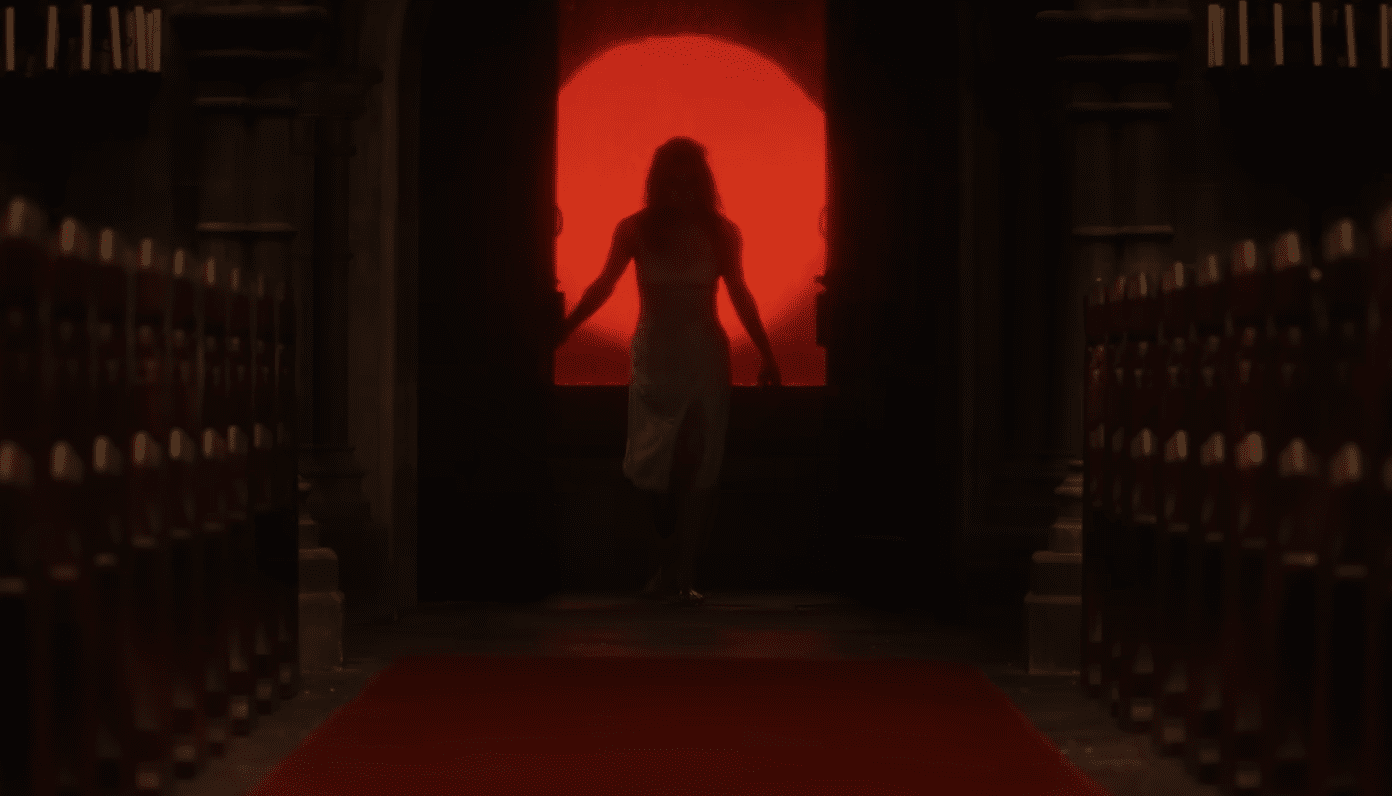
Image taken from Reactor
All three Knives Out films have explored the exploitation of women under systems of privilege and power. In Knives Out, Martha’s kindness and generosity is taken advantage of by her rich employers who look down on her. In Glass Onion, Andi is murdered for trying to do the ethical thing, just so that her so-called friends can retain their lifestyle and uphold their ego. In Wake Up Dead Men, the audience is shown how the male figures of the Church have benefited from the oppression of the women. At the start of the film, Martha (Glenn Close), Monsignor Wicks’ assistant, was introduced as a victim as she had to keep the church’s diamond safe. She tells the myth of Grace—Wicks’ mother, seen by the town as “that harlot whore”–and how she broke into the church to steal the diamond after his grandfather's death. The visual scenes and dramatic tussle that ensued between young Martha and Grace complemented this power dynamic of victimhood and villainy respectively. However, in the denouement, it was revealed that Grace was only reclaiming what was rightfully hers. Martha herself realised when the story was told objectively that like her, Grace was also silenced and bound by the church’s lies and deceit. Grace’s story is recounted over and over through the subjective biases of the other characters, who chose to villainize a single mother and reduce her to a label they considered sinful, instead of helping her. Indeed, both Grace and Martha may have seemed like villains to the audience, but after the narratives were ‘fact-checked’ for biases,it becomes evident that both of them were merely doing their best to survive within a system determined to shame and snuff them out.
To Wicks, religion is about power and control. He prefers to enforce rules over his flock, drawing attention to and enhancing the divisions that exist between groups (seem familiar?). He is satisfied when people leave at the end of his sermon because it proves just how powerful he is. He encourages all the congregants of his Church to treat religion as a transaction instead of an honest practice of faith, whether it is by extorting Simone (Cailee Spaeny) for her money or by taking advantage of Martha’s loyalty (Glenn Close), the church of Our Lady of Perpetual Fortitude becomes Wicks’ place of worship, not God’s.
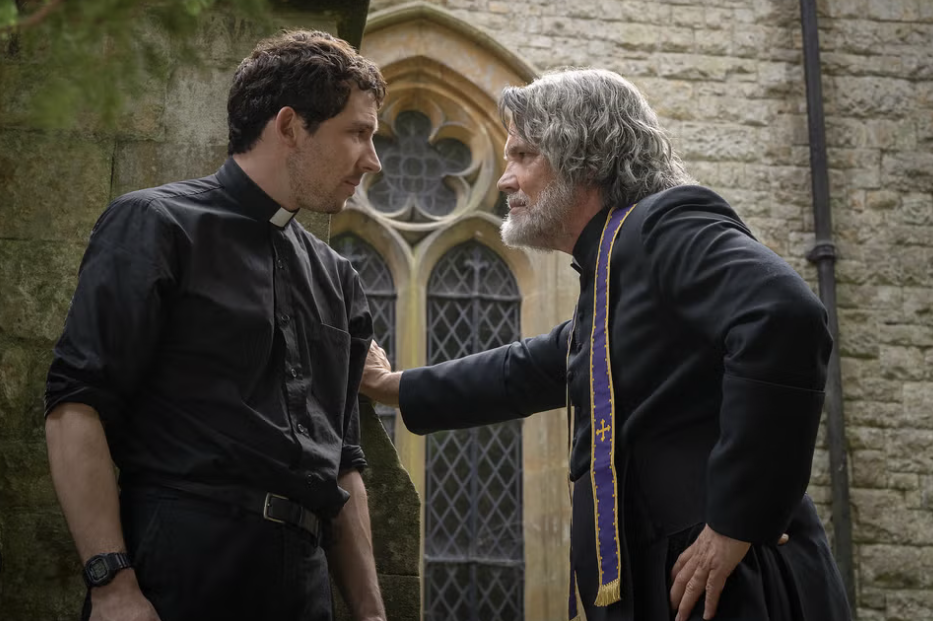
Image taken from ELLE
Conversely, Father Jud carries out his duties in a quieter manner and prefers to have open conversations between himself and the flock, inviting them to one-on-one discussions. Jud’s leadership and stewardship towards the church members’ aims to connect while Wicks’s leadership divides, upholds and promotes toxic behaviour. More importantly, Jud’s accommodating and selfless nature allows for his followers to confide in him. In one of the most sincere moments in the film, Jud calls the construction company the Church engages with, to figure out vital information he and Blanc require for their investigation. It is here that he talks to Louise, an employee, who repeatedly diverts the conversation towards irrelevant topics, leading to a comedic bit wherein Jud has to revert her attention. A conversation via text or phone is often transactional, with one party often asking another for help and ending it when they have obtained what they want. Yet, when Louise explains that her mother is in the hospital and asks Jud to pray for her toward the end of their conversation, Jud cannot find it in himself to hang up and ignore her plea. Instead, he shuts the door on Blanc and by extension the investigation, so that he can devote his time and attention to Louise. Jud’s belief that religion can provide comfort and is meant to help those in need is something he takes seriously, he is someone who embodies the teachings of God, all he wants is to do good by the Church and its congregation. By contrasting Monsignor Wicks’s and Father Jud’s respective approaches to religion, it is clear that the film argues that humility, compassion, and the choice to help (without any ulterior motives) is the way forward to becoming a better human being.
Another reason why Jud’s character stood out to me was how much I related to his struggles with self-doubt. Despite knowing for a fact that he had not killed Monsignor Wicks, Jud had decided to confess to the murder. It is heavily implied that he wanted to take the blame (‘take one for the team’) to resolve the problem. This is significant because his confession is synonymous with sentencing himself to death. Watching this, I related a lot to Father Jud. How many times have I doubted myself because of my past or present weakness(es)? How many times have I convicted myself of crimes that I did not commit? How many times have I overextended myself for people who frankly, did not deserve it?
In the nick of time, Blanc whisked Jud away from his confession, forcing him out of the idea of himself being the killer. I have had many Blancs in my life–therapists, friends and even family members, who see me in a clear, objective light,who absolve me of my self-doubt, religious & non-religious guilt–by encouraging me to see myself beyond my weaknesses and reminding me of my strengths and purpose.
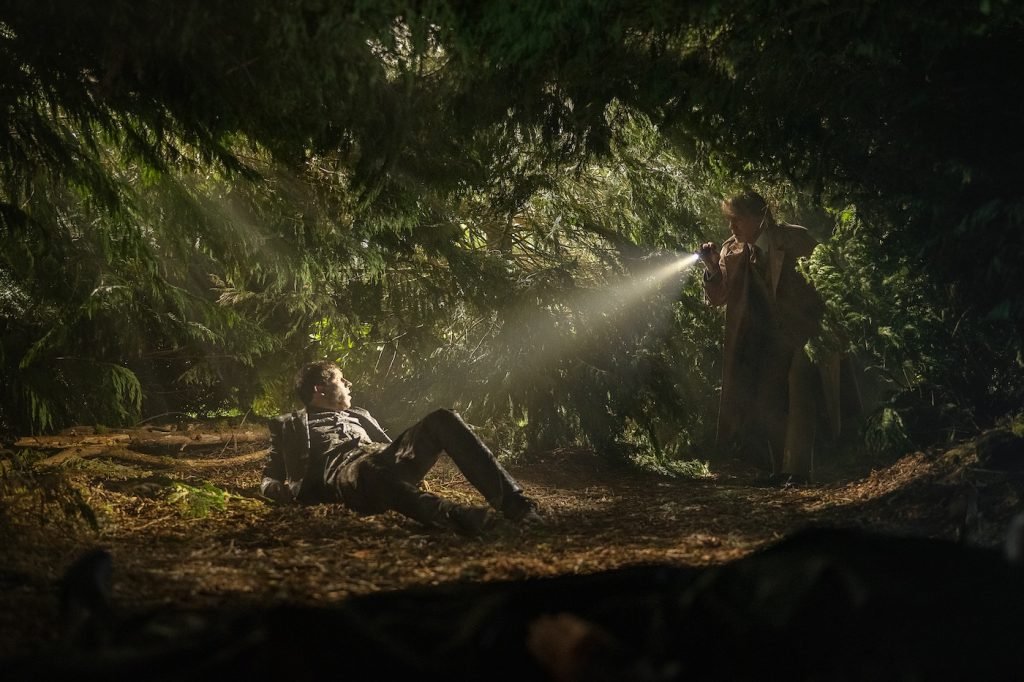
Image taken from Motion Picture Association
Speaking of light, it is a huge motif throughout the entire film, one that is executed beautifully through the cinematography . In particular, a scene that stood out to me was when Detective Blanc first meets Jud, and warm light suffuses the entire atmosphere in the church. The stained glass windows allow the light in, with the red in the red carpet, oranges and purples in the scene looking especially warm. This mirrors the congenial, light conversation between Blanc and Jud. Yet, when Jud asks Blanc “how does all this make you feel?” Blanc's gaze sharpens along with the subtle edge in his tone. Tellingly, the light shifts and suddenly the whole scene turns darker and cooler. In a close-up, Blanc’s face is underexposed and it seems as if all the warmth has been sapped out of it as he growls the line, “it’s like someone has shone a story at me that I do not believe.” Mirroring the complex and troubled history and feelings Blanc expressed about the Catholic religion and church, the dim and cool lighting complements the solemn facial expressions both Blanc and Jud have. After Blanc’s rant about the Catholic church’s evils, there is silence followed by a shot of Jud just staring at him. As Blanc fidgets about, shadows move around Jud’s face yet his smile remains sincere. It is this smile that is the only source of warmth in the scene and ultimately communicates Jud’s openness towards conflicting beliefs (and ‘non-believers’) to the audience.
As Jud agrees with Blanc that the entire church’s architecture and practices are storytelling, a warm ray of light enters and backlights Jud’s silhouette. It’s growing intensity lends emotional weight and credence to Jud’s statements. The change and shifts in light replace the need for scores and music, working in a subtler way to enhance dramatic impact and add depth to the characters. Indeed, the shift in light from warm to cool then to warm again truly complements Jud’s ability to inject warmth into conflict and emotional maturity in his ability to engage in open-minded conversations with people with contradictory opinions. If Wicks was in the same position, he would definitely have an incensed reaction to Blanc’s atheism and accusations, metaphorically beating him to a pulp with his retorts.
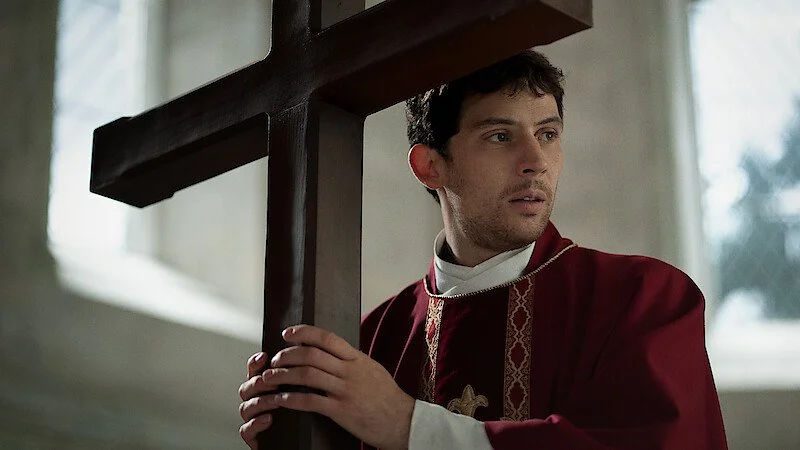
Image taken from Netflix
In the final scenes, Blanc encourages Father Jud up to do “what he was born to do” - be a priest and take the parishioner’s confession. Father Jud truly demonstrated equanimity and compassion as he holds the killer in his arms, absolving her of her guilt and sin before she passes. Witnessing Father Jud’s journey and his consistent humility and compassion despite his inner turmoil melted the cynic in me and perhaps, ever so slightly, made me believe in God again.
The latest instalment of the Knives Out franchise proves that casting the right actor is crucial when a film is so thematically rich, and it makes all the difference in telling an original, layered story that lingers in viewers’ minds. Father Jud’s strong commitment to his values and beliefs despite being in a stifling environment demonstrated his true character and ultimate strength - his selflessness. In essence, Jud’s journey encouraged me to look beyond my past and to focus on what truly matters - getting more character development and increasing my levels of selflessness.
Thank you to my editor Venesya for contributing to this piece.
Images in this article are being used under Fair Use guidelines as part of Singapore's Copyright Act 2021.