
Pluribus (2025-): The Most Miserable Woman in the World and Her Emotional Support Hivemind
Editor-in-Chief Venesya Mayvelie Kosasi considers how Pluribus (2025-) serves as an allegory for colonialism, revealing that the real horror of the show is rooted in the inequalities and marginalization already transpiring in real life. And even beyond that, through its nuances, that the show challenges our conception of what it means to be human–who are we, if we must rethink reality?
This review contains spoilers for the first season of Pluribus (2025-)
Pluribus (2025-) feels simultaneously like a combination of many stories I’ve loved, but also a completely new and unpredictable rollercoaster of a show that confronts the many issues plaguing our modern world.
So it should come as no surprise that I’ve fallen in love with it.
Created by Vince Gilligan, most known for his critically acclaimed series Breaking Bad (2008-2013), Pluribus follows accomplished fantasy author Carol Struka (Rhea Seehorn) who finds herself in the aftermath of a semi-apocalyptic event. Caused by a mysterious virus originating from 600 lightyears away—later deemed “The Joining”—the invasion strips humanity of their individual consciousness, seizing total control of everyone’s bodies—bar thirteen people, one of which, includes Carol. Needless to say, Carol is not having a great time. Reeling from this traumatic event and the tragic loss of her wife to the mass assimilation, Carol’s attempts to adjust to her new normal is shaken by the arrival of Zosia, “one of them”. Styled according to Carol’s notion of an ideal woman, Zosia (Karolina Wydra) arrives as a "gift" from the nebulous hivemind controlling most of humanity, a “chaperone” to look after Carol’s desires; Zosia is clearly a thinly veiled attempt by the alien virus to bide time as they develop a method to convince Carol to “join” them. Her immunity, as it seems, might not protect her forever.
Carol is really going through it.
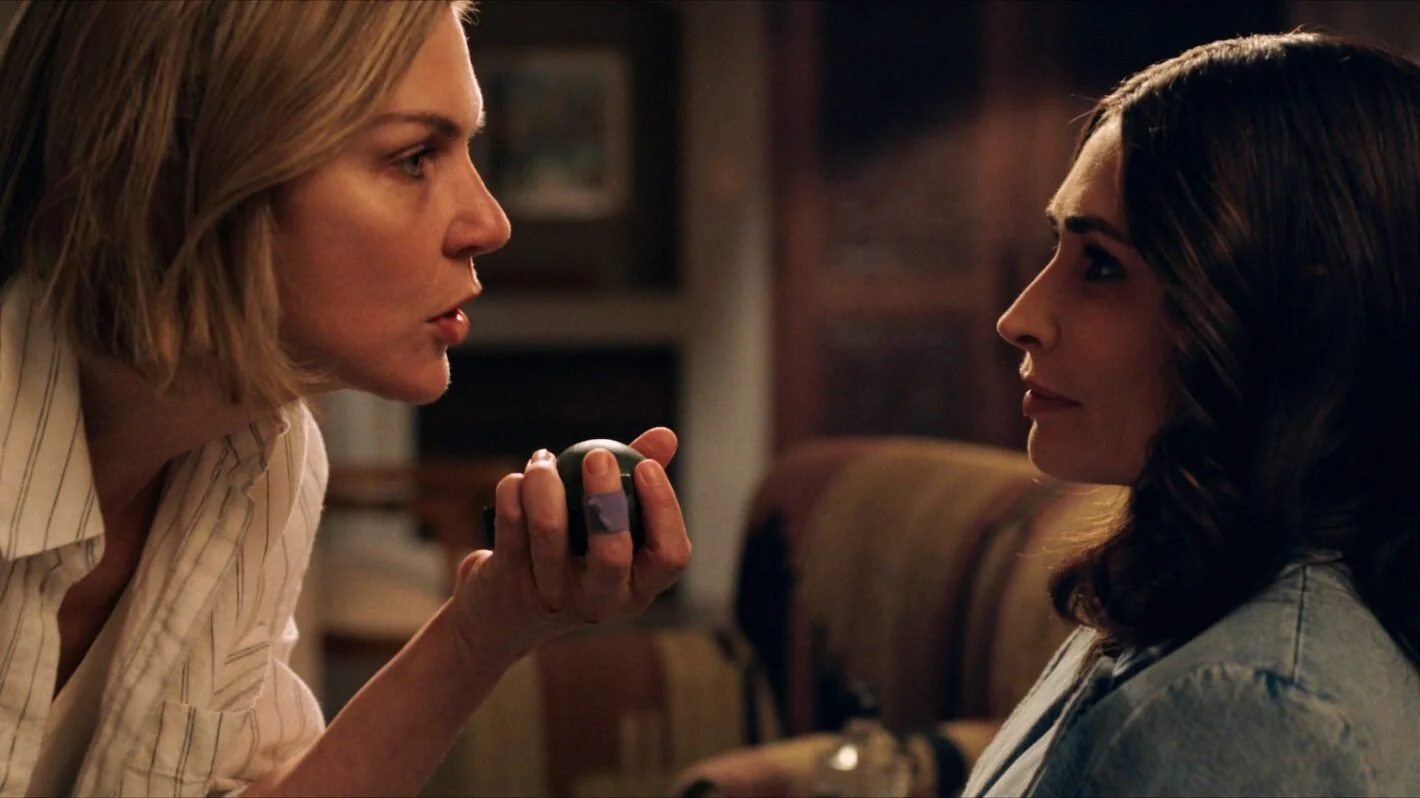
Image taken from TV Insider
In the earlier episodes of Pluribus, I couldn’t help but notice the hivemind’s uncanny resemblance to the destructive and obsequious nature of AI. With the knowledge of all the humans it has turned at its disposal, the hivemind can answer and provide almost anything at an unimaginable speed and scale. That most of the other immunes except Carol and Manousos (Carlos Manuel Vesga) have happily embraced the presence of the hivemind and continuously exploit their willingness to accommodate, gaining material benefits for themselves—a task as mundane as taking out one’s own trash becomes something one can delegate to the hivemind—feels very much like a critique of society’s overreliance on AI for the simplest tasks, and how it intrudes upon our everyday lives, sometimes even without our consent of knowledge. Much like AI, the hivemind dehumanises the people it takes from, it effaces them, stripping them of their individuality and identity. And though it might seem like a straightforward criticism of AI, it’s not a farfetched belief to say that Pluribus is also a metaphor for the other dangerous and violent terrors that persist in the world.
One of the more interesting aspects of Pluribus’s storytelling is its refusal to portray the hivemind as ‘evil’. The show depicts this new world as some strange utopia, more uncanny, than outright terrifying. Since everyone is now just an extension of the virus, there is no conflict, and hence no crime or violence. One of the survivors even remarks that racism is now a nonissue. In its singularity, the hivemind has also eradicated inequality—energy is conserved, and the environment is likewise protected. As we stumble after Carol in her quest to learn more about them to restore the world, we are also left to grapple with their own stance on the mysterious entity—which despite all its capabilities, itself strangely remains unaware of its own origins. Yet, as the episodes unfold and we become privy to more, the always sinister but sometimes forgotten aspects of the hivemind begin to bubble to the surface. It might not present as traditionally villainous, but I don’t think it’s a stretch to say that the horrors of Pluribus might also reflect those of Colonialism.

Image taken from TechRadar
The hivemind tries tirelessly to sell “The Joining” as a serene and peaceful experience through rhetoric: it desires to “share their gift". But there is no denying that their desire to subjugate the universe is oppositely invasive and dehumanizing. This is most evident in the last episode, beginning in a Peruvian village wherein one of the immunes, Kusimayu (Darinka Arones) resides. As we find, the hivemind has successfully created a compound customised to each immune and capable of converting them. It is here that Kusimayu, whose entire village had been turned, anxiously but willingly waits for her assimilation. Meanwhile, the villagers, clad in traditional clothing, sing and dance around her, maintaining the pretense of normalcy.
However, once Kusimayu awakens as one of them, they drop the act, and everyone abruptly leaves. The animals once under the care of the villagers chase after them, but the villagers do not look back. They are not villagers, or at least, they no longer parade as one. They are the hivemind, and the hivemind is indifferent. The abandonment of Kusimayu’s village symbolizes the demise of meaning and authenticity, and it then becomes clear that any participation of culture by the hivemind was just a facade to placate Kusimayu before they could successfully convince her to join them. “The Joining” is not gentle, it is not happy. Just like that, an entire village, an entire way of living has been eradicated. Like colonialism, the hivemind’s joining is a brutal practice that erases culture and tradition.
Despite her apprehension, Carol still engages with the quasi-alien-virus entity, even coming to like them, or at least Zosia. Manousos, however, refuses to, going so far as to starve himself than accept any food provided by the hivemind. In his words: “Nothing on this planet is yours. Nothing. You cannot give me anything, because all that you have is stolen. You don’t belong here”. Manousos approaches the hivemind with extreme distrust and is unafraid to engage with them violently. His stance seems to echo Frantz Fanon’s argument in his paper “Concerning Violence”, that any sort of successful decolonization and anti-colonial movement cannot be achieved with “non-violent resistance”, especially not when colonial exploitation has always itself begun with violence. Which again, presents us with another question—is there a correct' way of decolonising?

Image taken from Feature First
Something to note, however, when it comes to Pluribus is that it is a much more nuanced situation than just the fear of being taken over or colonised. The presence of the hivemind forces the characters and in extension, the audience, to consider what it means to be human—it challenges the very conception we have of the world as we know it. The threat of assimilation becomes the collapse of meaning. In Orientalism, Edward Said discusses the Other as the false image constructed by the West that generalizes and reduces the nuances of non-Western cultures to assert their colonial control and marginalize them further. In Pluribus, Carol and Manousos keep referring to the hivemind as “the others”—they reiterate to one another their separateness from them. The distinction then becomes more about retaining humanity as they understand it, than about 'othering' what one does not understand– what one finds unfamiliar–the way colonizers do.
This made me think about how the immunes in fact do not understand the virus-entity and that is what leads them to label the hivemind as “other”; Zosia tells Carol that she does not know what it means to be them, but they know what it means to be her. And naturally, what is unfamiliar is seen, subconsciously, as a threat to the self; the hivemind is naturally framed as an aggressor or antagonising force by the immunes, and by us, too. But while discussing the morality of the hivemind with my brother, he remarked that the reproduction of the human species is not unlike the hivemind’s likewise biological imperative to multiply and survive. Obviously from our perspective, the hivemind’s manipulation and intentions are dehumanizing, but can we call it ‘evil’ just because it isn’t human? Isn’t the implication that—as opposed to the hivemind—humanity is inherently ‘good’, also a problematic assumption that generalizes?
The show uses Carol and Manousos as metaphors for different approaches towards the hivemind and what it represents. And though their different personalities will undoubtedly continue to be a source of conflict in future seasons of the show, I think it’s important to note that both Carol and Manousos in their own methods, go against the hivemind’s isolation tactics, by reaching out to one another—seemingly echoing the sentiment that change cannot be accomplished, if no action is taken.
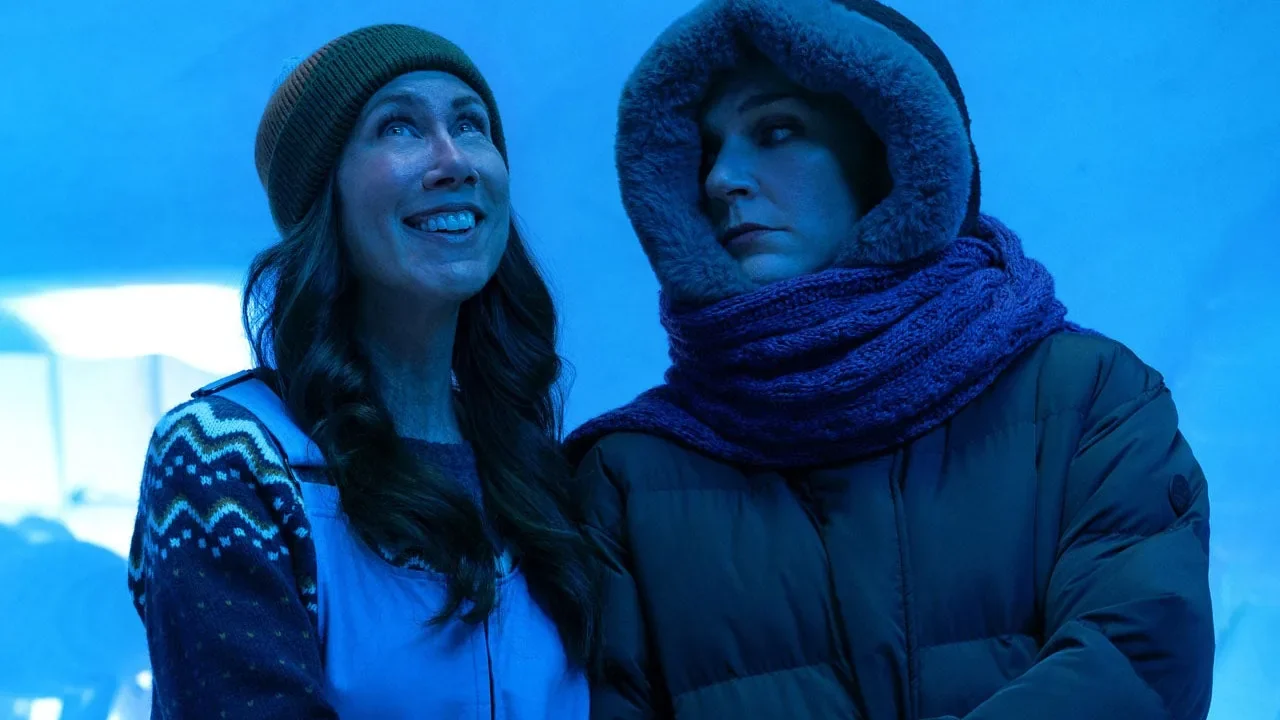
Image taken from IGN Southeast Asia
This leads us to another theme I think is important to address because most of the discourse I've seen online seems to disregard Carol’s queer identity—some calling her a Karen for not wanting to “join” the hivemind…really? Others even call her pathetic for giving in to her attraction. What’s happening to media literacy? It seems everyone wants a complex character until it’s a woman. I think the show makes it evidently clear that her identity as a lesbian woman is crucial to understanding her character, as well as her motivations.
Through Carol, Pluribus explores themes of conformity, grief, and trauma. It is revealed that as a teen, Carol was forcibly sent to a conversion camp by her mother. She likens the hivemind to her camp counselors then, who smiled all while they tried to erase her sexual identity and force her conformity, in the exact same way the hivemind has now done to the rest of the world. As a queer woman who has been forced to conform her whole life, of course Carol wouldn’t want to lose her autonomy and individuality to the hivemind.
This context makes her dynamic with Zosia much more interesting. Carol knows Zosia is not real. Or at least that the Zosia she has come to know—and infuriatingly come to like despite her best efforts—is not the real Zosia per se, but an extension of the hivemind calculatedly presented in line with Carol's ideal type of woman. But her connection to Zosia goes far beyond just physical attraction. In a sense, the hivemind is the only tie she has left to her deceased wife, Helen, who had joined the hivemind briefly during The Joining, before dying from a seizure. Carol obviously blames and detests the hive for Helen's passing, but she cannot resist asking them about her. And this makes sense. She will never hear Helen’s voice again, never hold her again, but through the Hive, she is able to reanimate her in some way through Zosia, retaining Helen’s memories and her thoughts. Zosia is but a living proof—a gorgeous 5’9 one—of the love and life they had shared, and that which continues to haunt her.
In that view, I don’t think anyone can fault her resolve wavering in her grief.

Image taken from Decider
Then there is also the fact that it is not just grief that erodes her resolve, but also the surprising comfort that the hive presents. Carol still remains deeply traumatized by her experience at the camp. It is revealed that the popular male love interest of Wycaro—Carol’s fantasy series, which she calls mindless crap—was initially meant to be a woman, but this was changed out of her own fears and for commercial appeal. It is not difficult to grasp that much of Carol’s dissatisfaction with her own work and career is tied to its straight-acting, for a lack of a better word, and how she not only does not have autonomy over her sexual expression, but also her creative output.
After spending more time with Zosia however, Carol finds the motivation to write again. When presenting the draft of the newest Wycaro book to Zosia, she reveals that the love interest is now a woman, as they were always meant to be. “Long overdue,” Carol admits. As such, Carol’s connection to Zosia and the hivemind is so compelling because they offer her this utopia where her queer story isn’t held back by heteronormative expectations and its rigid frameworks. It allows her the chance and the freedom to be herself honestly.
Of course, Carol and the audience are aware that their dynamic is confusing and problematic. One of the messages in the ending seems to be that when comfort enables ignorance, it means being complicit in the problem. And though she is not completely blameless, I think people seem to forget that Carol was socially isolated, manipulated, and psychologically tormented. Carol remains in a traumatic situation and has barely had any time to process the things she’s been put through. God forbid a woman is a complex character and might want to cling to any companionship and understanding that presents itself to her, never mind if it's a facade or not. Carol and Zosia’s relationship is so much deeper than simply attraction.
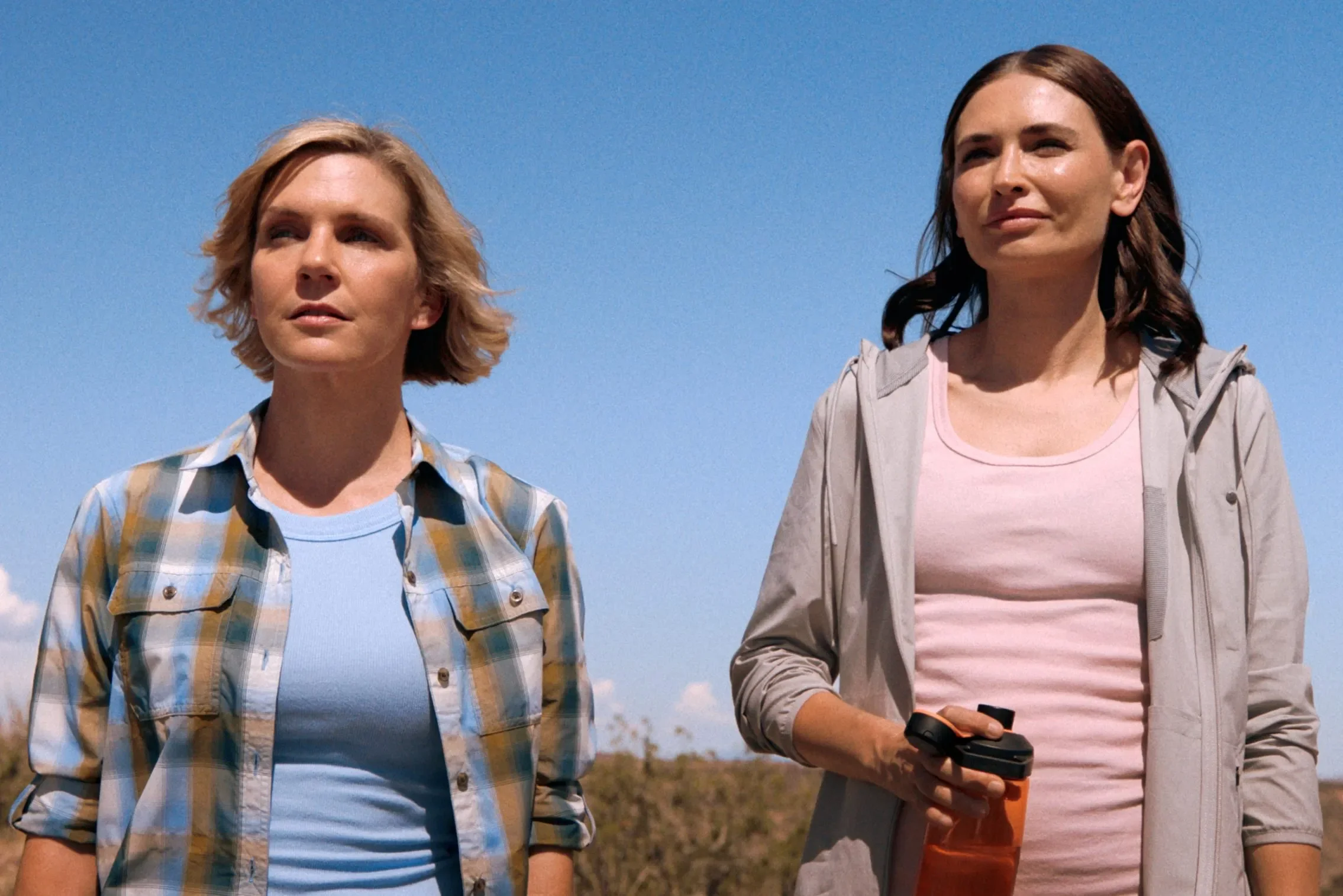
Image taken from Variety
The domination in Pluribus might not be bloody, but it is just as violent. It smiles. It appeases. It is colonization disguised as comfort, and that, at least to me, makes it more sinister, because it makes it harder to recognise. Pluribus, for one, speaks to the ongoing erasure against marginalized groups and to representation—as exemplified by the eradication of Kusimayu’s culture. But if I were to think further, it might even lend to reflections on the erasure of lives worldwide, its links to ongoing genocides, neocolonialism, and exploitation. And most of all, the discourse surrounding Carol's choices has also failed to recognise how her personal experiences with her sexuality have informed her decisions.
With so many things unanswered and the finale leaving things as strained as they are between Carol and Zosia, it’s hard to say what the characters and the state of the world will look like in the second season of the show. But with what we have now, Pluribus exists as an allegory of inequalities, in AI, in colonial dynamics and in sexuality. It’s meant to challenge the audience to think critically about the themes they’ve been presented with.
And if Pluribus seems to be a cautionary tale, it isn’t. The premise it proposes is already occurring in real life. We don't even have to speculate. Looking at Pluribus itself as a queer-centric television series, its contemporaries are being cancelled left and right: Shera and the Princesses of Power (2018-2021), despite being a Netflix original, is soon to be removed from the platform. The homogenisation in Pluribus doesn't seem farfetched: it's already actively happening around us, albeit quietly and discreetly.
A single way of life, of thinking, that is what Pluribus warns against.
Thank you to my dear co-editor Cheng Hao and my brother for bouncing off ideas with me, and to my friends for indulging in my Pluribus obsession.
Images in this article are being used under Fair Use guidelines as part of Singapore's Copyright Act 2021