
The 4PLY Clandestine System
Editor-in-chief Goh Cheng Hao reflects on Natalie Sin’s The 4PLY Clandestine System, premiering at the 36th Singapore International Film Festival (SGIFF), amid our culture of the viral online persona, representation, and tissue paper.
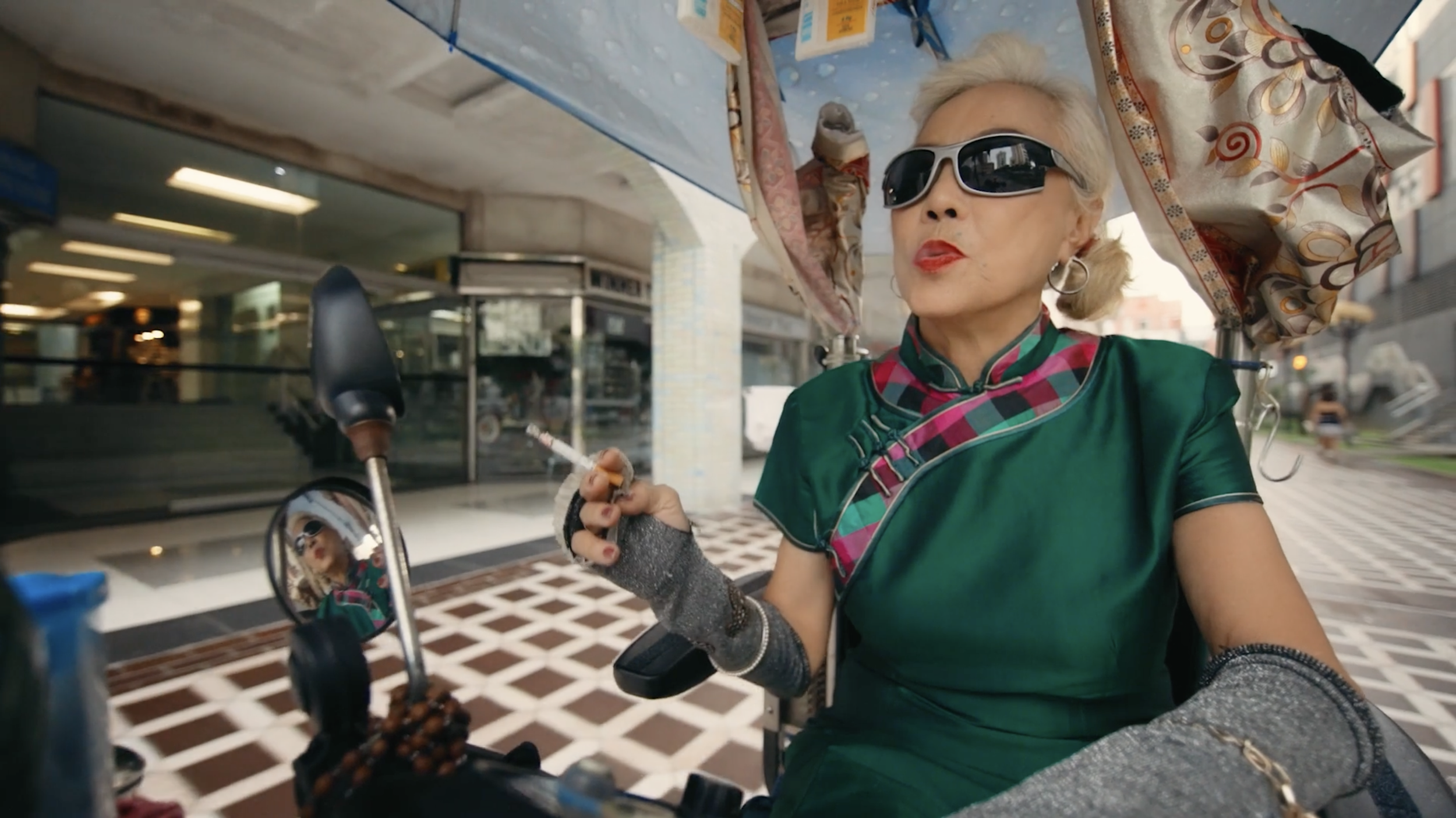
Still from The 4PLY Clandestine System, courtesy Natalie Sin.
Tissue paper is truly a medium of contradictions. It’s fascinating how polarising of a position it exists in our lives. To many, it is salvation. It arrives as a knight in shining armour, delivering you in biblical fashion from the embarrassment of snot. It accompanies you when tears are shed. It knows you intimately (and knows your intimates). It is a symbol of care across the dinner table. Tissue is everywhere. But at the same time, it is invisible to us for most of its lifespan. Strangely enough, it only exists when it ceases to exist. It is hyper-expendable, only meaningful to us in its short use, then tossed aside. Tissue is simultaneously essential and disposable. It is both valued and debased. And as we find, these contradictions aptly find their way into Natalie Sin’s short The 4PLY Clandestine System.
On its surface, The 4PLY Clandestine System follows two opportunistic documentary filmmakers as they tail Maryanne, an eccentric tissue peddler. Beyond her endearing and fashion-forward exterior, however, she is revealed as the kingpin orchestrating an elaborate tissue paper peddling syndicate. Maryanne is nothing to sneeze at, however. With her loyal contingent of PMD-riding minions in tow and a cigarette in hand, she marks her territory, intimidating new goons to serve her growing empire. It feels almost colonial. One can only imagine her conquest into other neighbourhoods and to what might be eventual world domination.
But apart from its absurdist premise, behind its pulpy layers, The 4PLY Clandestine System speaks of a more salient concern. This is not a film necessarily concerned about the intricacies or legality of a ragtag tissue paper cartel, as exciting as that might be. The issue at hand is a more sobering one. The 4PLY Clandestine System highlights the ethics of journalism and documentary. It reflects on the ethics of representation, the ways in which we fiddle and toy with peoples’ lives.
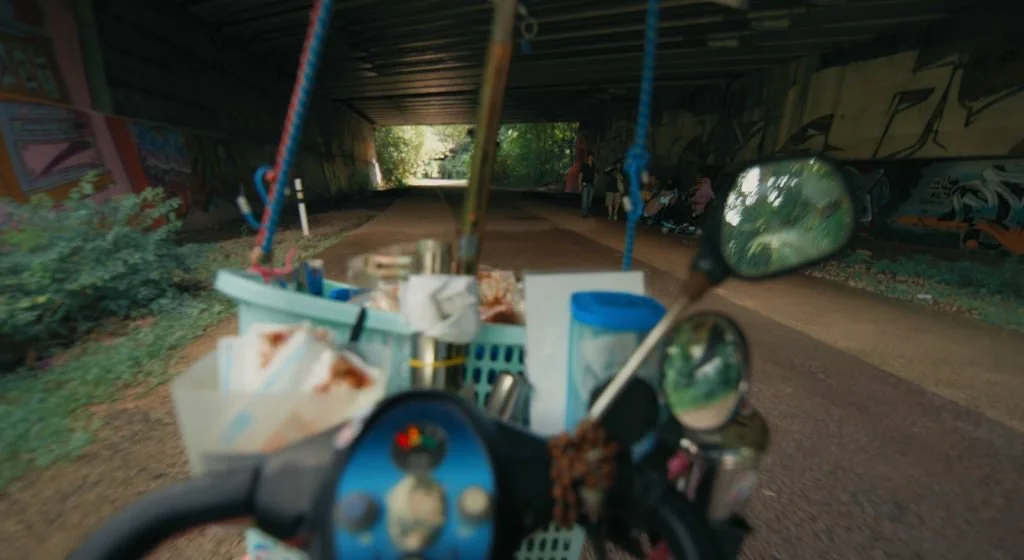
Still from The 4PLY Clandestine System, courtesy of Natalie Sin.
Admittedly, Maryanne is the perfect profile for a feature story. She’s visually striking, animated, and most of all, peculiar. And in a country where conformity is the norm, social oddities, for a lack of a better term, find themselves exoticised, like an aberration to be scrutinised or investigated, and at worst, ridiculed. As it stands, there is an ever growing list of Singaporean ‘cryptids’ that attests to how we sensationalise these people: Turritopsis Dohrnii Teo En Ming Zhang En Ming Time Traveller, Kurt Tay, the late Big Hair Lady, Wangan Bryan, Plastic Bag Zhen Zhen, Steven Lim, Radical Kindness, Uncle Raymond, etc.* Across the years, an entire genre of local mythological figures has been accumulated and canonised. The antisocial hence has cultural relevance, and journalism knows this full well.
As passive onlookers, we might find them entertaining, or as an easy moral (or self-identifying) reference to punch down at: “Phew, thank god I’m not like that.”. It reassures us of our ‘normalcy’. However, these spectacles are not just symptomatic of the mental toil of contemporary Singaporean life, but are also testament to the way we reduce people to their cultural value, to mere entertainment. In the two filmmakers’ process of shooting, despite inklings of a more nuanced, formative past, Maryanne is threatened to be reduced to a social novelty; reduced to a school assignment that, once finished, finds itself neglected in the recesses of drives; she is purely content to be consumed. At best, she becomes a convenient metonym for the disappearance of culture, à la the tissue peddler in Tan Pin Pin’s Singapore Gaga, or fuel for a thinkpiece on the elderly loneliness epidemic; a piece on late-stage capitalism? Perhaps a reaching article on the resurgence of local gangsterism?
But all this aside, the embellishments and editing, at the heart of it all, the question lies: Who’s narrating whose story? We conveniently forget that these are people too, with their own lives and stories, more than just their use value or odd image. At the end of the day, no matter how outlandish, they are still people, people trying to make a living, trying to get on through the drudgery of life. In a sense, then, Maryanne and her type are not unlike the very wares she sells. She is valuable, but briefly, then later dispensed with and forgotten entirely.
It recalls the 2017 documentary The Center Will Not Hold about writer-journalist Joan Didion’s oeuvre. Didion recounts her well-known "Slouching Towards Bethlehem” essay on sixties’ San Francisco. In which, amidst hippie culture and recreational drug use, Didion had witnessed the harrowing scene of a five-year-old high on LSD and psychedelics. She’d remarked, saying: “Well, let me tell you, it was gold…You live for moments like that if you’re doing a piece, good or bad.” Without a doubt, empathy is key. And yet, it is also undeniably true that being a reporter, journalist, or filmmaker demands a certain emotional detachment. Someone needs to write the piece, after all. These are stories that still need to be told. But there are ways in which we can engage with them more carefully, more decently.
As The 4PLY Clandestine System uncovers, journalism and filmmaking are rife with these one-sided relationships. It is a system perpetuated by institutions, by our attention economy, by the society of the spectacle. It’s also as if to say, those that aren’t interesting enough aren’t worth any of our attention either. We take and take needlessly from other peoples’ lives, to produce into content, but very rarely, if ever, do we give in return. It asks us, confronts us, even: how can we maintain a decent, moral eye?
The 4PLY Clandestine System premieres at SGIFF’s Southeast Asian Short Film Competition Programme 3, on the 5th of December (Friday), 9.30pm. Get your tickets while you can!

Still from The 4PLY Clandestine System, courtesy Natalie Sin.
*Special thanks to Hui Yee for supplying the longlist of local online mythological figures.
Images in this article are being used under Fair Use guidelines as part of Singapore's Copyright Act 2021